 Loading...


PRODUCT DETAIL -
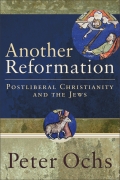
| PRODUCT TITLE | ANOTHER REFORMATION |
| ISBN NUMBER | 9780801039409 |
| CATEGORY TYPE | THEOLOGY |
| AUTHOR/EDITOR | PETER OCHS |
| PUBLISHER | |
| PRODUCT Type. | |
| Summary | POSTLIBERAL CHRISTIANITY & THE JEWS |
| FORMAT | SOFTCOVER |
| SELLING PRICE | $41.00* |
| *price before member's discount | |

 |
|
DESCRIPTION
OUT OF PRINT
"The upshot of Ochs's careful, erudite, detailed argument is that postliberal theology escapes the traps of both liberal and antiliberal reason and so is not drawn to supersessionism. . . . Ochs, in his practice and in his exposition, exhibits a way of relating and thinking and believing that makes wholeness and healing possible."--Walter Brueggemann, Christian Century Jewish theologian Peter Ochs argues that a significant and expanding movement in recent Christian theology offers a way for Christians to rededicate themselves to the gospel message and to classical, patristic doctrines of the church without revisiting classical claims that, with the coming of Christ, God has replaced his love of the Jewish people with his love of the church. Ochs examines the christologies and pneumatologies of leading postliberal theologians George Lindbeck, Robert Jenson, Stanley Hauerwas, John Howard Yoder, Daniel Hardy, and David Ford, who argue in their work that God's love of Christ and the church does not replace his love of Israel and the Jews. Another Reformation not only provides a detailed study of the movement of recent postliberal Christian theology in the United States and the United Kingdom but also offers stimulating Jewish-Christian theological exchange. Ochs's realization that some Christian thinkers retain a place for the people of Israel opens up the possibility of new understanding and deepens the Jewish-Christian dialogue.
Contents
1. Introduction: Christian Postliberalism and the Jews
Part 1: American Protestant Postliberalism
Part 1: American Protestant Postliberalism
2. George Lindbeck and the Church as Israel
3. Robert Jenson: The God of Israel and the Fruits of Trinitarian Theology
4. Arguing for Christ: Stanley Hauerwas's Theopractic Reasoning
5. The Limits of Postliberalism: John Howard Yoder's American Mennonite Church
Part 2: British Postliberalism
6. Finding Christ in World and Polity: Daniel Hardy's Ecclesiological Postliberalism
7. Wisdom's Cry: David Ford's Reparative Pneumatology
8. John Milbank: Supersessionist or Christian Theo-semiotician and Pragmatist?
9. Conclusion: Christian Postliberalism and Christian Nonsupersessionism Are Correlative
-

GET THE LATEST UPDATES
Be the first to know when our store is offering discounts or when your favourite authors release their new books.
-


-

GET IN TOUCH WITH US
Call us at (65) 6227 9700 or email us at enquiry@sksbooks.com and we will get back to you as soon as we can.
