 Loading...


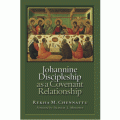
| PRODUCT TITLE | JOHANNINE DISCIPLESHIP AS A COVENANT RELATIONSHIP |
| ISBN NUMBER | 9781565636682 |
| CATEGORY TYPE | DISCIPLESHIP |
| AUTHOR/EDITOR | REKHA CHENNATTU |
| PUBLISHER | |
| PRODUCT Type. | |
| Summary | NA |
| FORMAT | NA |
| *price before member's discount | |

 |
|
DESCRIPTION
Rekha Chennattu breaks new ground in Johannine scholarship—and offers a first-class study of Old Testament covenant theology. Presenting a detailed exegetical analysis of the discipleship narratives and discourses in John’s gospel, she gleans further insight through her investigation into Old Testament discipleship motifs.
While not ignoring Hellenistic influence and the presence of the Samaritan and Greek Christians in the community, Chennattu sets the Johannine community firmly within the Jewish world. Opening a new chapter in Johannine studies, she concludes that, according to the Gospel of John, the relationship with God that had defined Israel as a people of God also defines the disciples of Jesus.
"Working on the literary, theological, and historical levels, Rekha Chennattu has produced a remarkably fine example of modern Gospel study. Her approach to biblical theology—embracing close readings of the Johannine discipleship texts, the biblicalmotif of covenant, Johannine theology in general, and the historical situation of the Johannine community— is a model of how this discipline can be carried out effectively and fruitfully. Her scholarly study of discipleship in John’s Gospel has important implications for understanding Christian life today."
—Daniel J. Harrington, S.J., Professor of New Testament, Weston Jesuit School of Theology
“This study of Johannine theology originated as a Catholic University doctoral dissertation under the direction of Australian scholar Francis J. Moloney, who also provides a Foreword to the volume. An Indian scholar, Chennattu links John’s theology of discipleship to the Old Testament notion of covenant. John, she believes, models the bond between Jesus and his chosen disciples on the bond between Yahweh and Israel, with similar emphasis on loyalty, mutual love, and obedience. Relatively few studies of Johannine theology have focused on the gospel’s notion of discipleship and this work contributes a thoughtful and creative framework for understanding the Fourth Gospel’s always intriguing and profound portrayal of Jesus and the community formed in his name.”
—The Bible Today
“This analysis of the theme of discipleship in John’s Gospel takes account of the principal Johannine discipleship texts, their OT background, and the relevance of the discipleship paradigm for the Johannine community. . . . Chennattu concludes that the Johannine presentation of discipleship is a Johannine rereading of the OT metaphor of covenant. She contends that this rereading reflects a definitive theological and sociological break between Israel and the new chosen people of God, as well as sensitivity toward community members of Samaritan and Greek origin.”
—NT Abstracts
“The theme of discipleship is an important item on the agenda of many churches these days, and the often negative role of the Fourth Gospel in Christian-Jewish relations is on the hearts of many church leaders and those they serve. This book addresses both of those concerns in helpful ways. The heart of it is an exegetical study of the theme of discipleship in the call stories in John 1, the farewell discourse of John 13-17, and the resurrection appearance stories in John 20-21. Rekha Chennattu gazes at these texts through the lens of the ‘covenant motif’ as it is developed in the OT/Hebrew Bible and seen in other literature of late Second Temple Judaism. Through this study, discipleship in the Fourth Gospel is shown to be not a theme new to the Christian literature, but rather, an important testimony to the deep roots of the Johannine community and this Gospel in the religious life of Judaism that surrounds it.
“For scholars engaged in research on the theme of discipleship and for church leaders wanting to ground their communities in solid biblical study, this book would be a valuable foundation. The theological centrality of the covenant motif, coupled with the importance of the Jewish festivals in the Gospel’s chronology of Jesus’ public ministry, the evident importance of synagogue worship in the life of the community, and the use of ‘Father’ terminology as a pious circumlocution for God, are not evidence of or even warrant for the separation of Christians and Jews. Rather, they allow the Gospel to be used as evidence of their intimately intertwined history. In that sense, this book can be a valuable tool for the crafting of the church’s ethical participation in Jewish-Christian dialogue.”
-

GET THE LATEST UPDATES
Be the first to know when our store is offering discounts or when your favourite authors release their new books.
-


-

GET IN TOUCH WITH US
Call us at (65) 6227 9700 or email us at enquiry@sksbooks.com and we will get back to you as soon as we can.
